
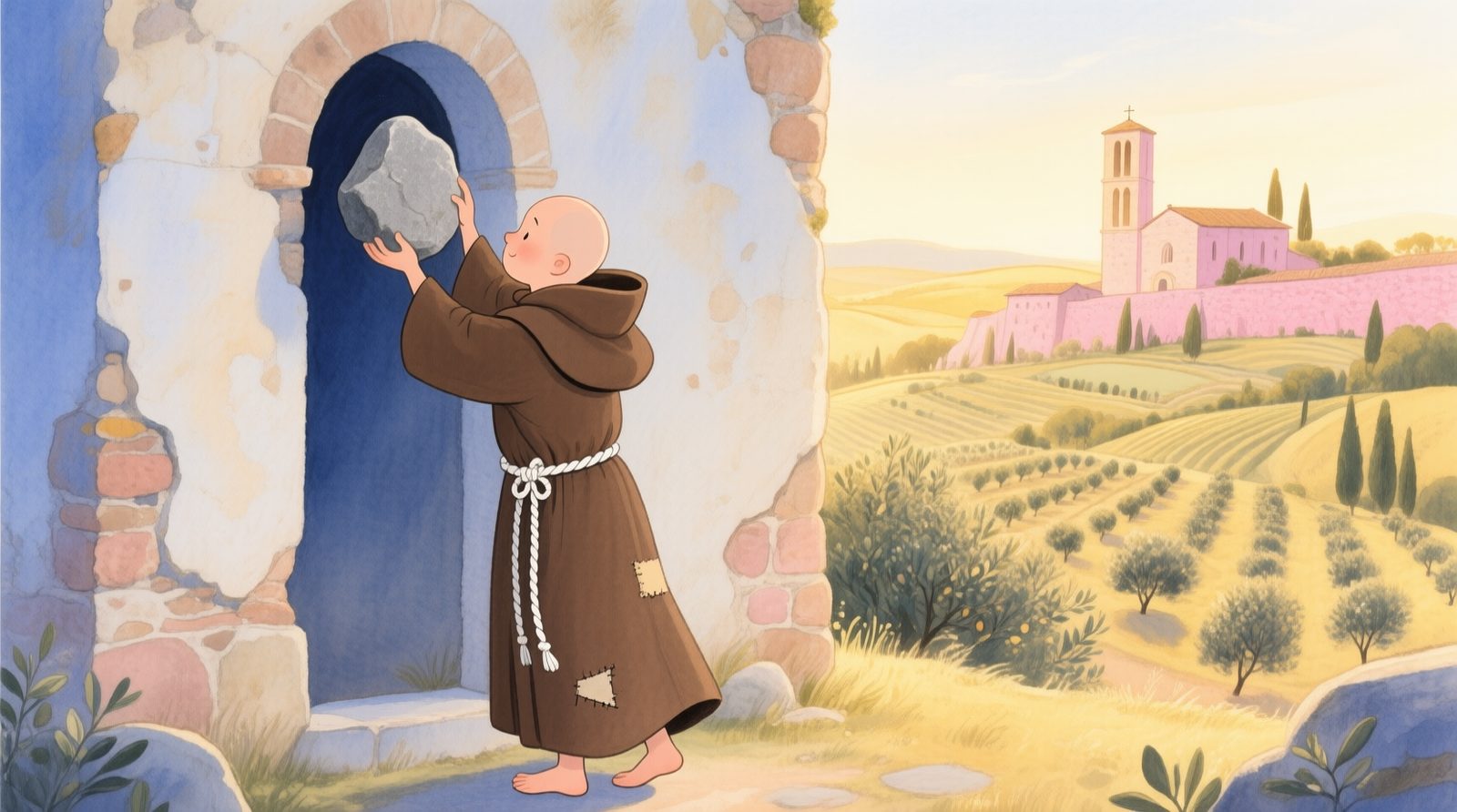
After giving up everything, Francis began his new life. He had no plan and no strategy — only an order from Jesus: to repair His house. And that is exactly what Francis did, quite literally: he began to rebuild the little church of San Damiano with his own hands.
The Begging Stonemason
Francis had never worked with stone, but he learned. He carried rocks, mixed mortar, laid bricks. And how did he get his materials? By asking. He went through the town singing:
"Whoever gives me one stone will receive a blessing. Whoever gives me two will receive two blessings."
People laughed and said the rich Bernardone's son had become a beggar. But some were moved, and brought him stones, timber, lime. And Francis worked cheerfully, singing hymns to God.
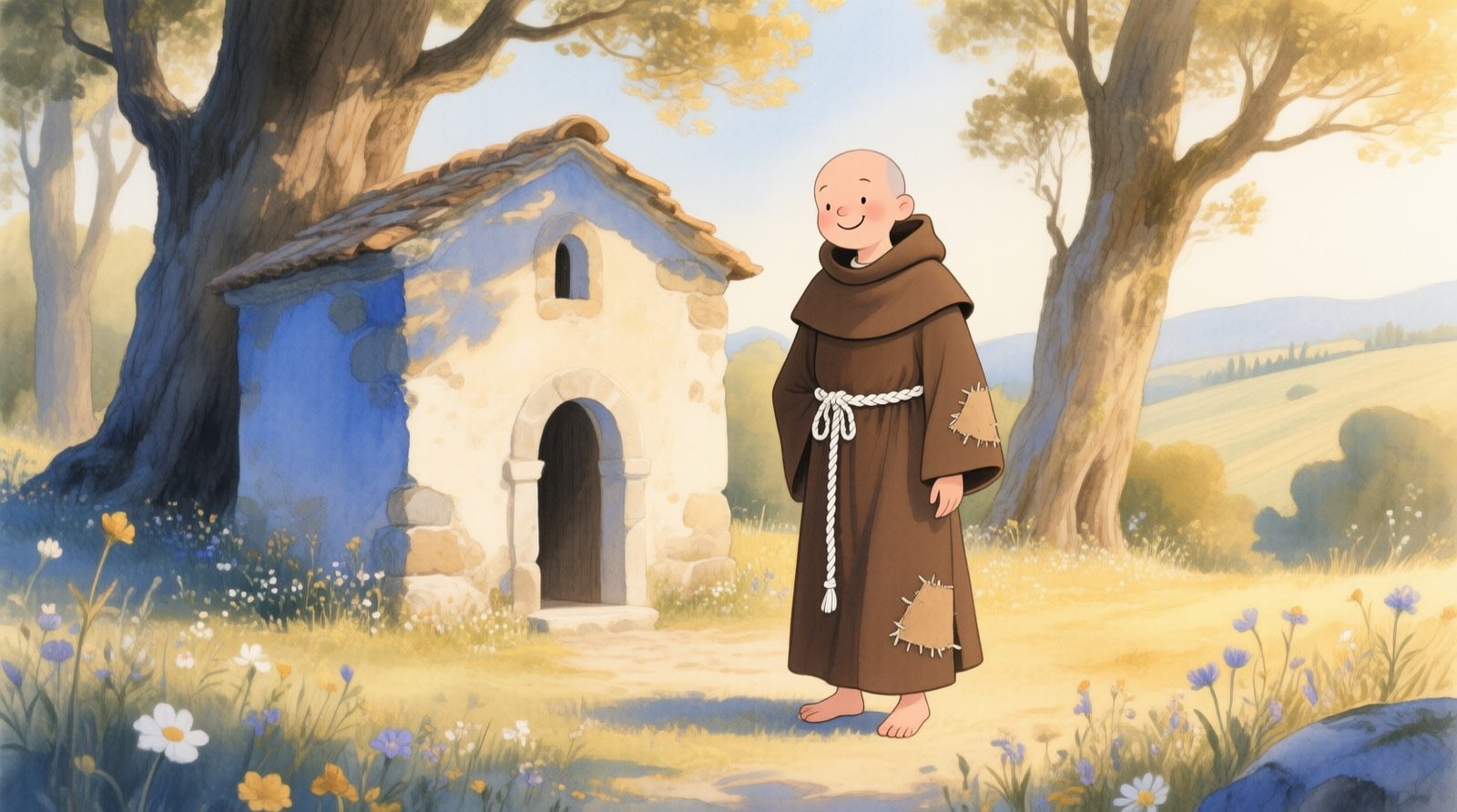
Little by little, the church of San Damiano was restored. Then Francis rebuilt another church, Saint Mary of the Angels, also called the Portiuncula: a tiny chapel, abandoned in the middle of the woods. Francis mended it with loving care, cleaned it, and made it beautiful. And that tiny little church would become the heart of the future Franciscan order.
The Mission Revealed
One day, Francis was at the Portiuncula attending Mass, and the priest read the Gospel in which Jesus sends out the apostles:
Francis felt his heart catch fire. This was what Jesus wanted of him. He left his shoes behind, left his staff, kept only a simple tunic, and tied a rope around his waist for a belt. He decided to live the Gospel to the letter. And he went out preaching along the roads: that people should repent, that the Kingdom of God was near. His greeting was always the same: peace and all good.
The First Followers
At first, many people thought Francis was mad — the young man who gave up everything to live like a beggar. But some noticed something different in him: a joy no one could explain, a deep peace. In 1208, a rich man named Bernard of Quintavalle grew curious. He wanted to find out why Francis was so happy while being so poor. He invited Francis to dinner and to sleep at his house and, during the night, pretended to be asleep so he could watch him.
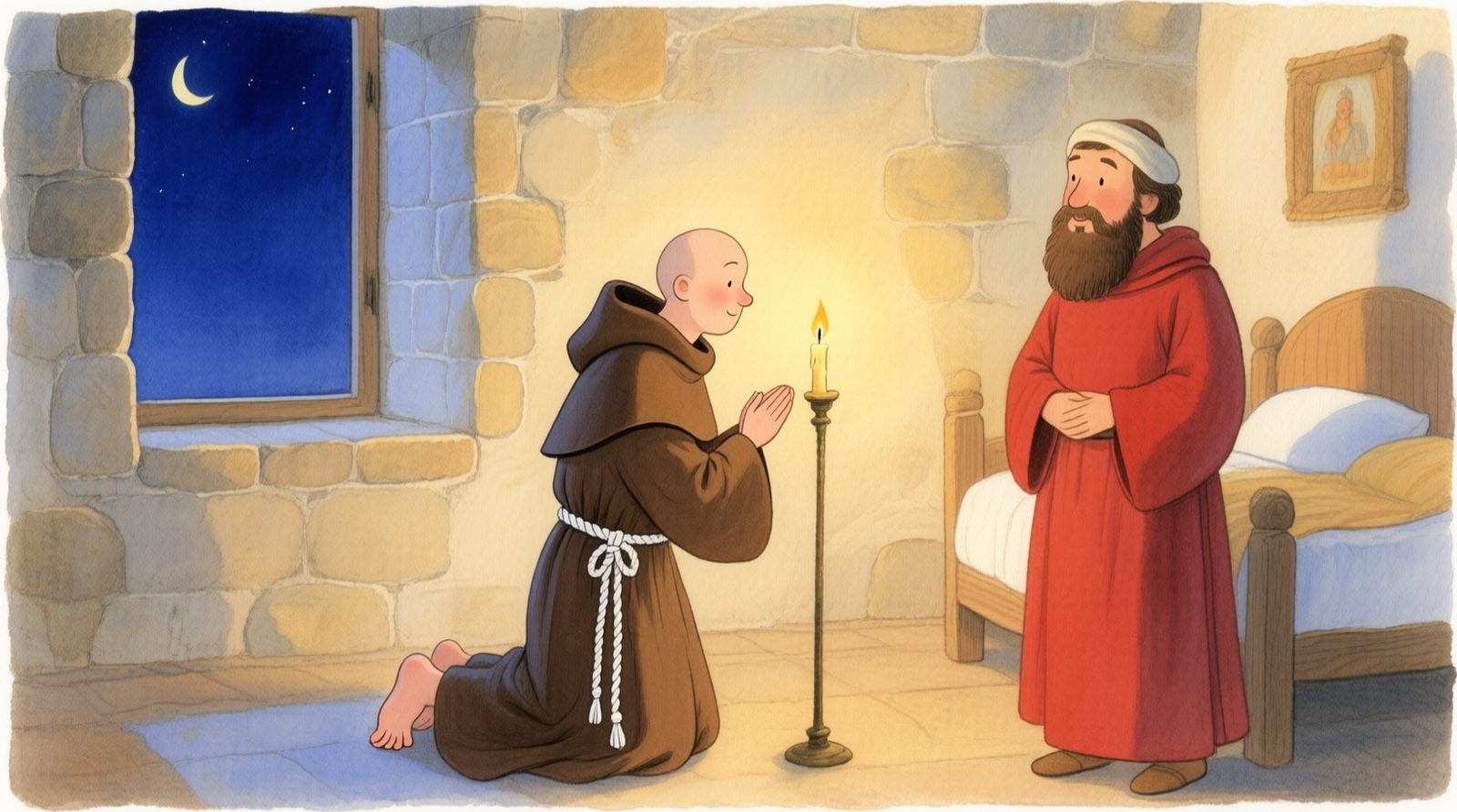
Francis spent the whole night in prayer. Kneeling, arms open wide, he repeated softly: "My God and my All. My God and my All." Bernard was deeply touched. This man truly knew God. The next day he told Francis that he wanted to live as he did. Francis was glad, and suggested they ask Jesus what He wanted. They went to a church and opened the Gospel at random, three times. The first time, they read: "If you would be perfect, sell everything and give to the poor." The second: "Take nothing for the journey." The third: "Whoever wants to follow me must deny himself."
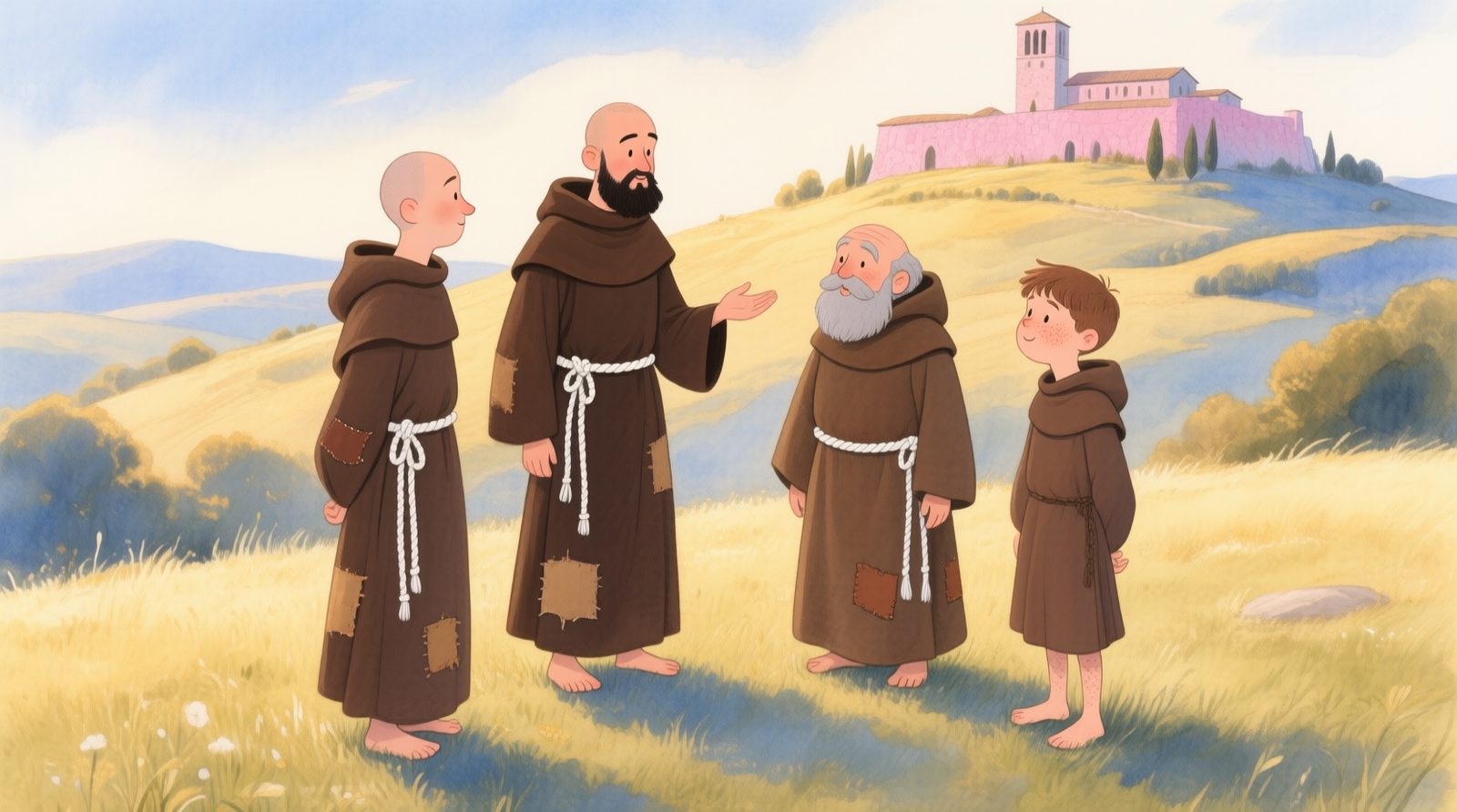
Bernard sold everything he owned, gave the money to the poor, and put on a simple tunic like Francis's. So the second Franciscan was born. Soon came the third, Peter Catani, a priest and doctor of law. Then came Giles, a simple man from the countryside. Within a few months there were twelve friars, like the twelve apostles. Francis called them the Friars Minor, because they were meant to be the least of all, the humblest.
The Radical Life
The friars lived in a radically simple way. They had no house: they slept in barns, in caves, under the trees. They had no money: they begged for their food or worked for it. Nothing belonged to any one of them: everything belonged to all. They spent their days preaching, helping the poor, caring for lepers, and they prayed a great deal, praising God at every hour. Some people were scandalized and called them madmen. Others were moved, and whispered that these men were saints.
Saint Clare
In 1212, a young noblewoman of Assisi named Clare heard Francis preach. She was eighteen, beautiful, rich, from an important family, and her parents wanted to marry her to a nobleman. But Clare did not want that: she wanted to follow Jesus as Francis did. In secret, she went to meet him and said she wished to live as the friars lived. Francis was surprised — a young woman could not live with them in the woods. But Clare insisted: Jesus was calling her too, and she had to answer.
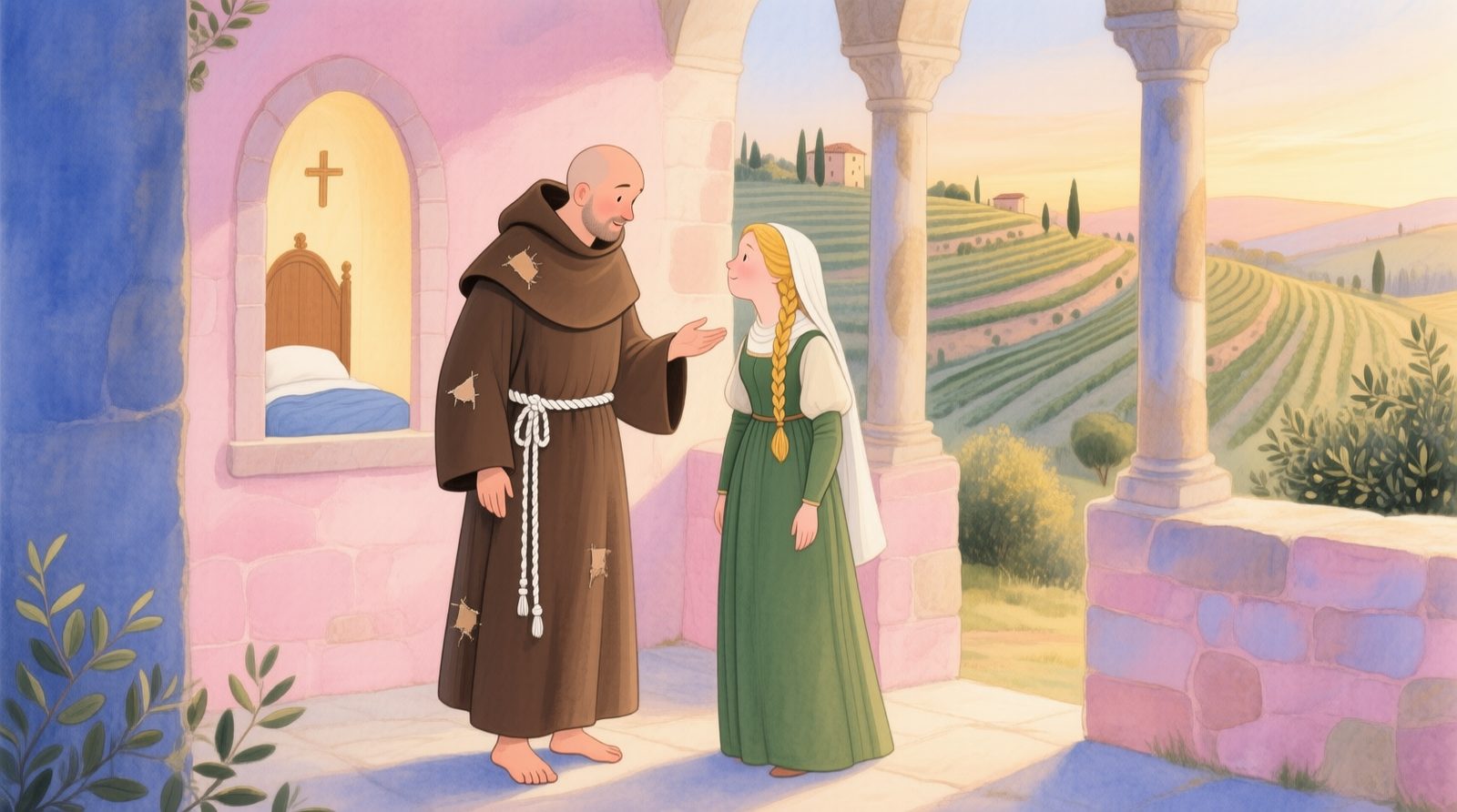
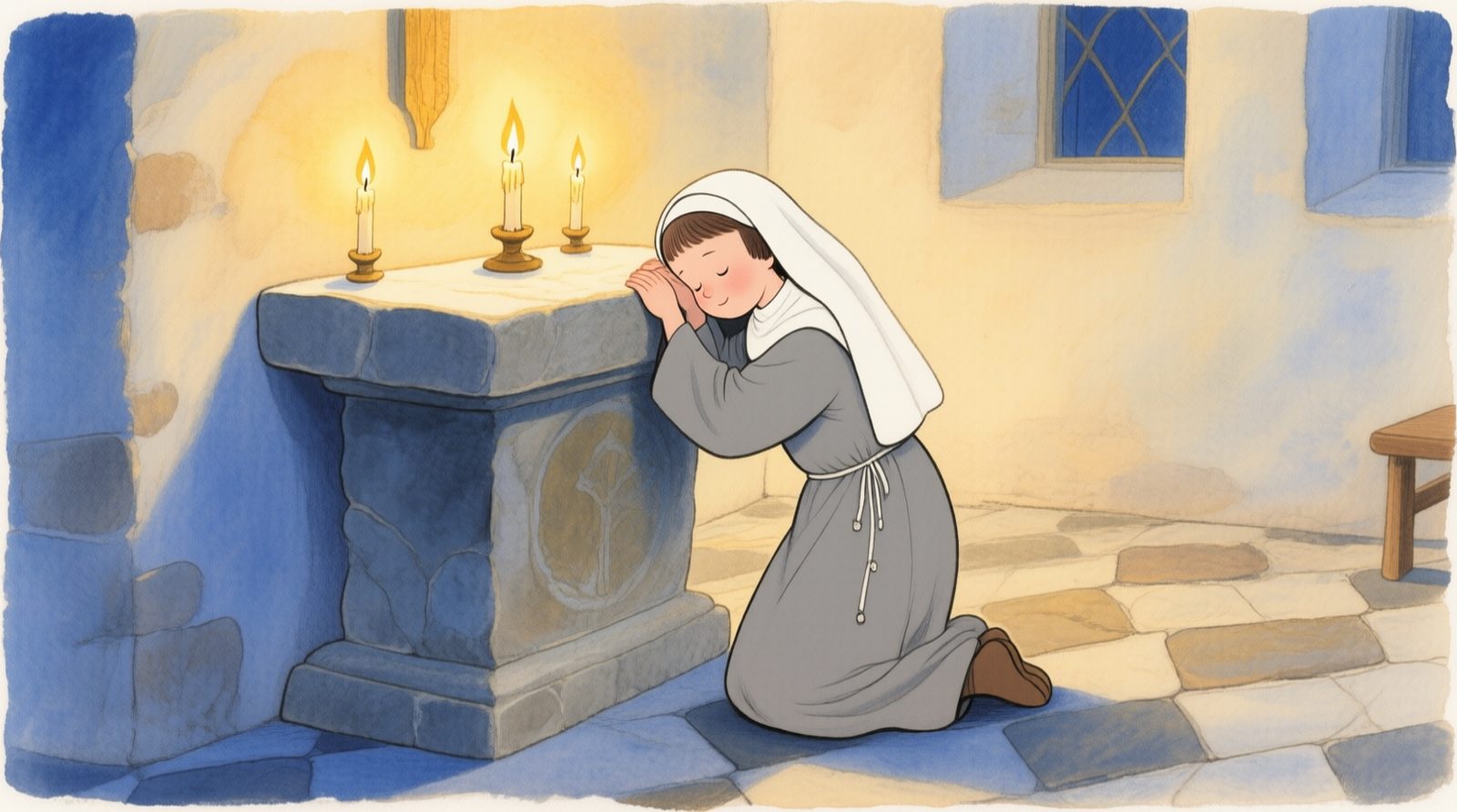
Francis and Clare arranged everything in secret. On the night of Palm Sunday, while everyone slept, Clare ran away from home and hurried through the dark to the Portiuncula, where Francis and the friars were waiting for her with lighted candles. Clare knelt down. Francis cut her long golden hair and gave her a simple tunic and a veil. That night, Clare became a bride of Christ.
Clare's family was furious, and they came armed to take her back. But Clare clung to the altar.
"I will not go! I belong to Christ now!"
She showed them her shorn head, and her relatives stood helpless. To drag her from the altar would be a sacrilege. They had to accept it. Clare was free.
The Pope's Approval
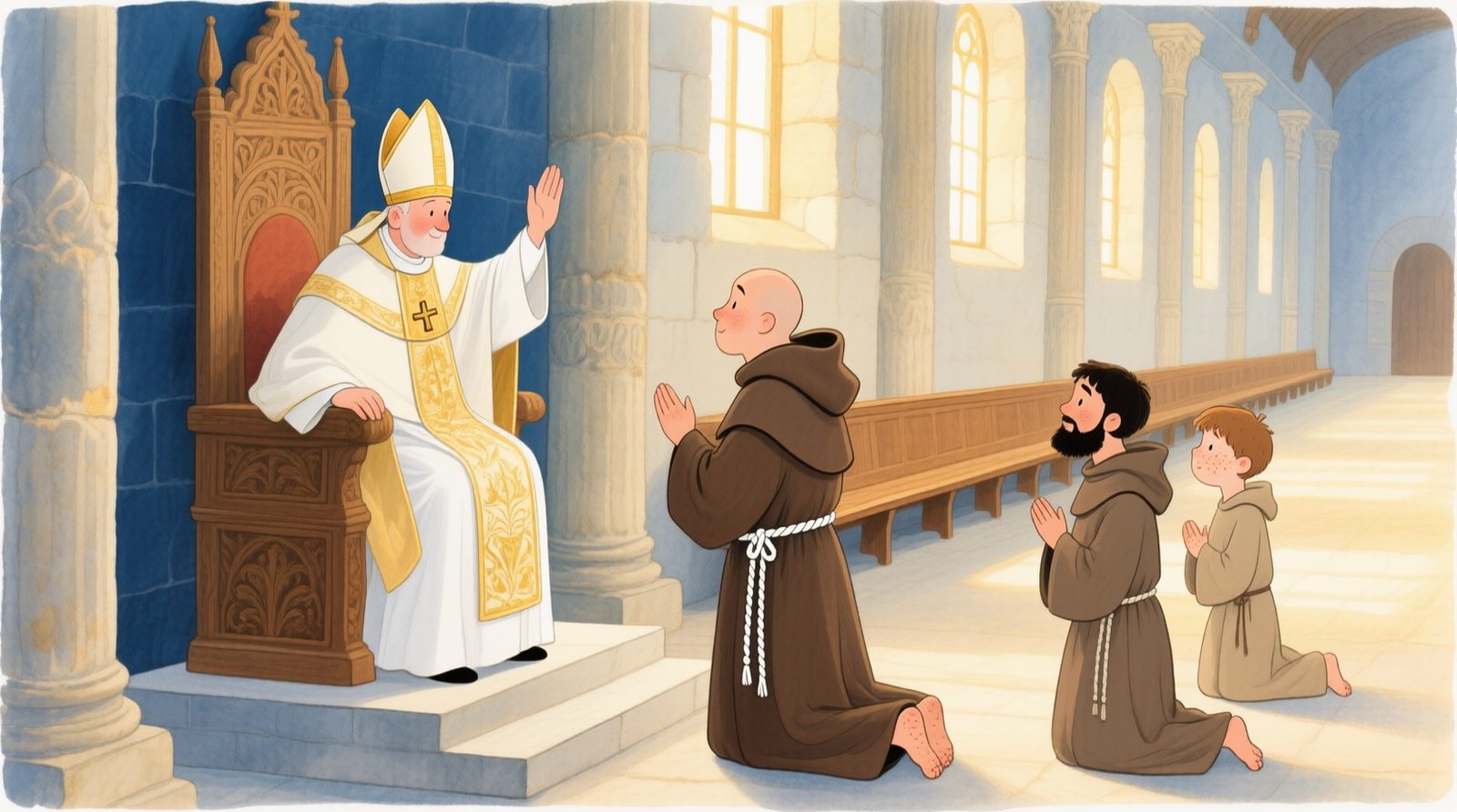
In 1209, when there were already twelve friars, Francis decided they needed the Pope's approval. He wrote a simple Rule — at its heart, to live the Gospel to the letter — and walked with the friars all the way to Rome. When they arrived before Pope Innocent III, they were dirty, poor, and ragged. The cardinals laughed at the beggars. But the Pope looked carefully at Francis.
The night before, the Pope had had a dream. He dreamed that the Basilica of Saint John Lateran, the cathedral of Rome, was falling — and that a small, poor man was holding it up on his shoulders, keeping it from collapsing. When he saw Francis, the Pope recognized the man from his dream. Francis asked humbly:
"Holy Father, we only wish to live the Gospel."
The Pope was moved.
"You are mad... but it is the madness of Christ. I approve."
And so the Order of Friars Minor was officially approved.
Francis and the Sultan
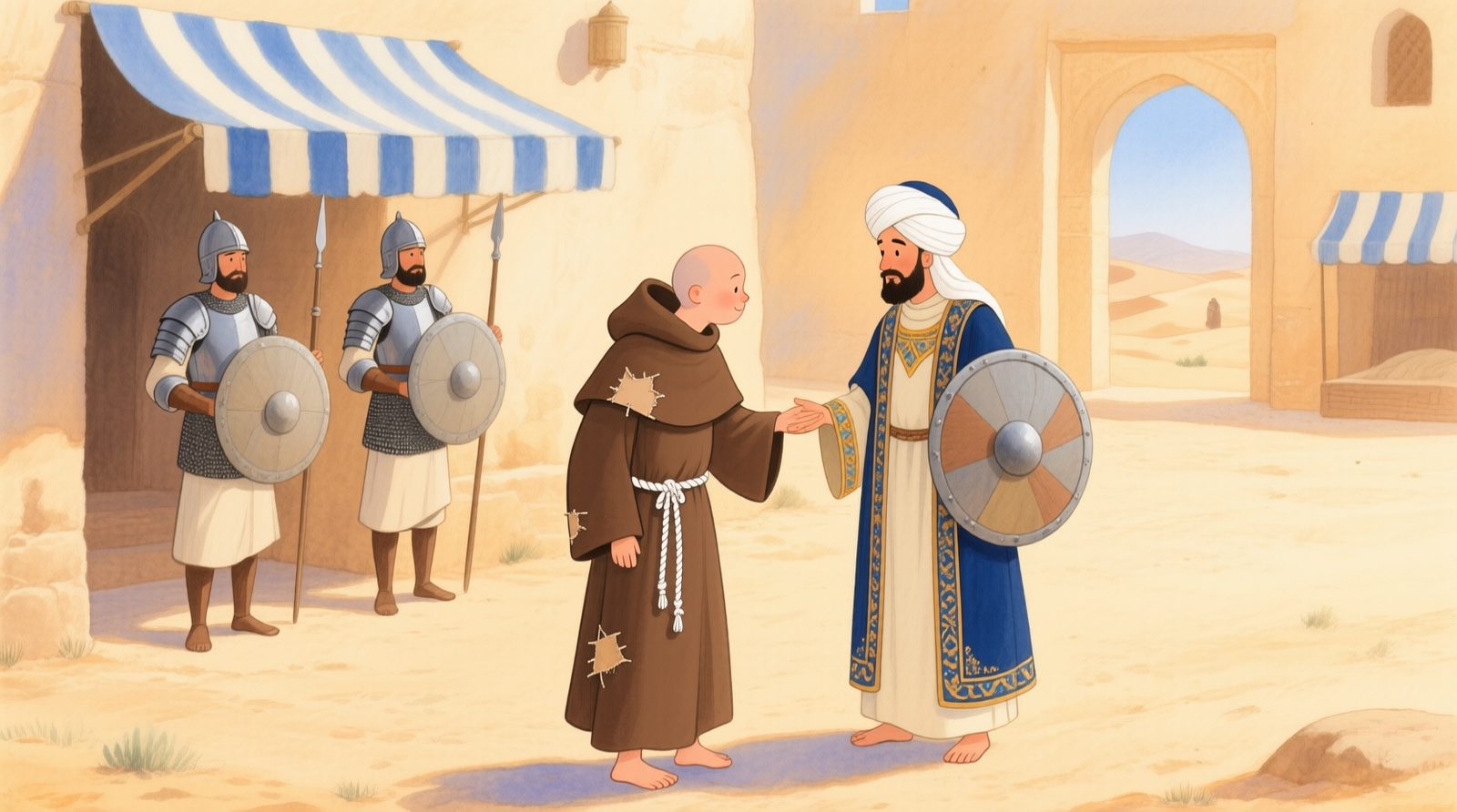
In 1219, during the Fifth Crusade, Francis did something extraordinary: he went to Egypt in the middle of the war, because he wanted to speak of Jesus to Sultan Al-Kamil. Everyone warned him that he would be killed, but Francis went anyway. He crossed the battle lines, was captured, and was brought before the Sultan, who was intrigued by this strange man, so poor and yet so cheerful.
"Why have you come? To convert me?"
"I have come to speak to you of Jesus Christ," Francis answered respectfully.
And he spoke of Jesus with such love that the Sultan was charmed. He did not convert, but he became Francis's friend. He offered him gifts, and Francis refused them all: he wanted no gold, he only wanted the Sultan to know Jesus. Deeply impressed, the Sultan confessed that he had never met a Christian like this — if all Christians were like Francis, he said, he would believe. He let Francis go free and protected the Christians in his lands.
The Growth of the Order
When Francis returned from Egypt, he had a shock: the Order had grown to thousands of friars, with convents, schools, and organized structures. Francis grew sad, afraid they were becoming rich again and losing their simplicity. He tried to return to radical poverty, but the Order was now too large. Then he understood that he had to let others lead. He gave up the government of the Order and went back to being a simple friar.
Moral of the Story


