
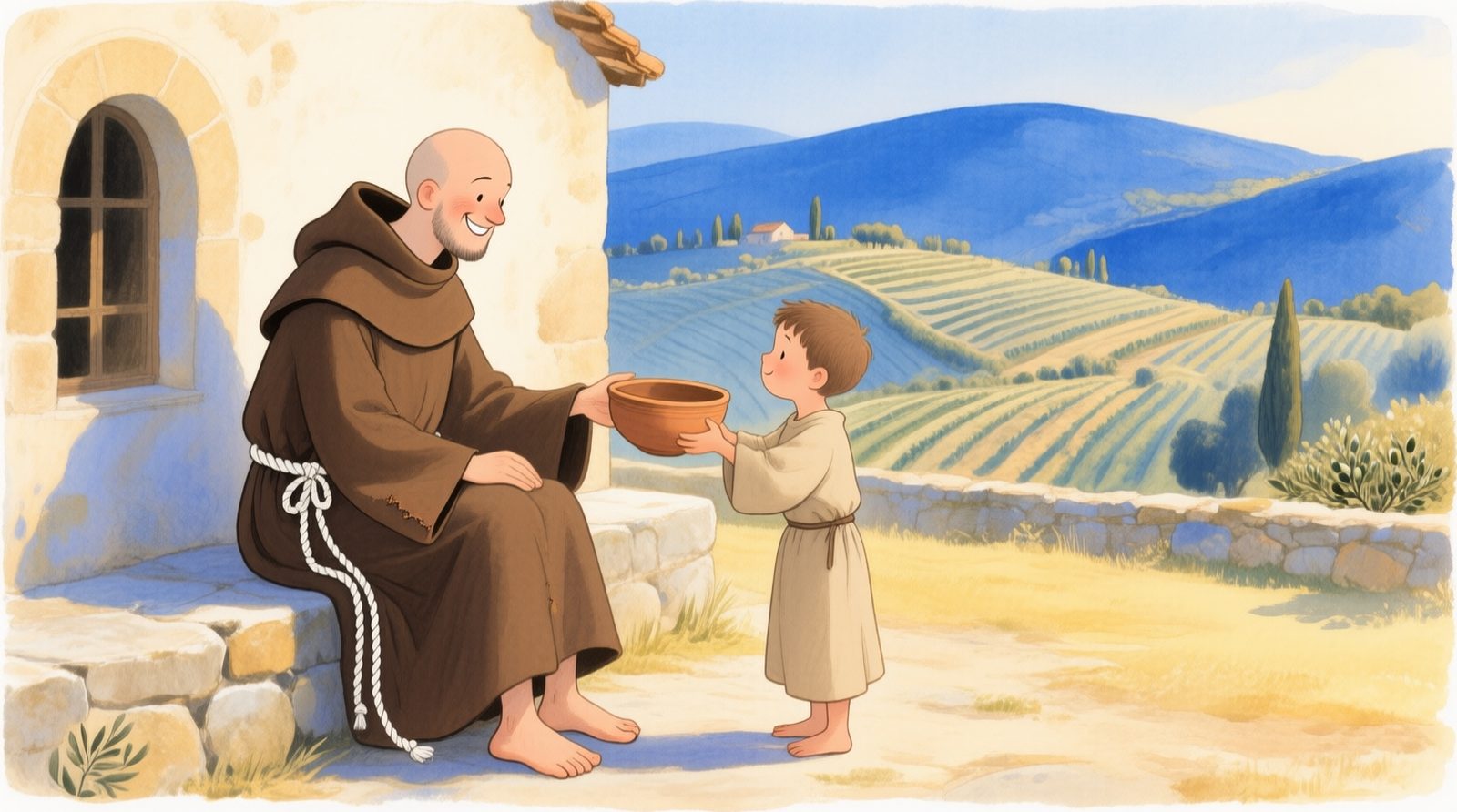
Francis's last years were full of suffering in his body, but full of joy in his soul. He was only about forty, and his body was already worn out: years of hunger, cold, hard work and illness had taken their toll. Even so, Francis never complained. He offered everything to God and said, with a smile:
"Welcome, my sisters the illnesses."
Francis's Illnesses
Francis had several serious health problems. He suffered from malaria, caught in Egypt, and the fevers laid him low. His eyes were diseased, nearly blind, and light caused him terrible pain. His stomach, worn down by fasting, ached without rest, and so did his hands and feet. But he never asked for relief. Instead, he gave thanks quietly: thank you, Lord, for letting me share in the sufferings of Christ.
The Retreat on Mount La Verna
In September 1224, Francis decided to make a spiritual retreat in a lonely place called Mount La Verna: a high, rocky mountain covered in thick forest. He wanted to be alone with God, to pray, to meditate. He took only a few friars, who kept their distance. Francis built a simple hut and, for forty days, he fasted and prayed almost without stopping.
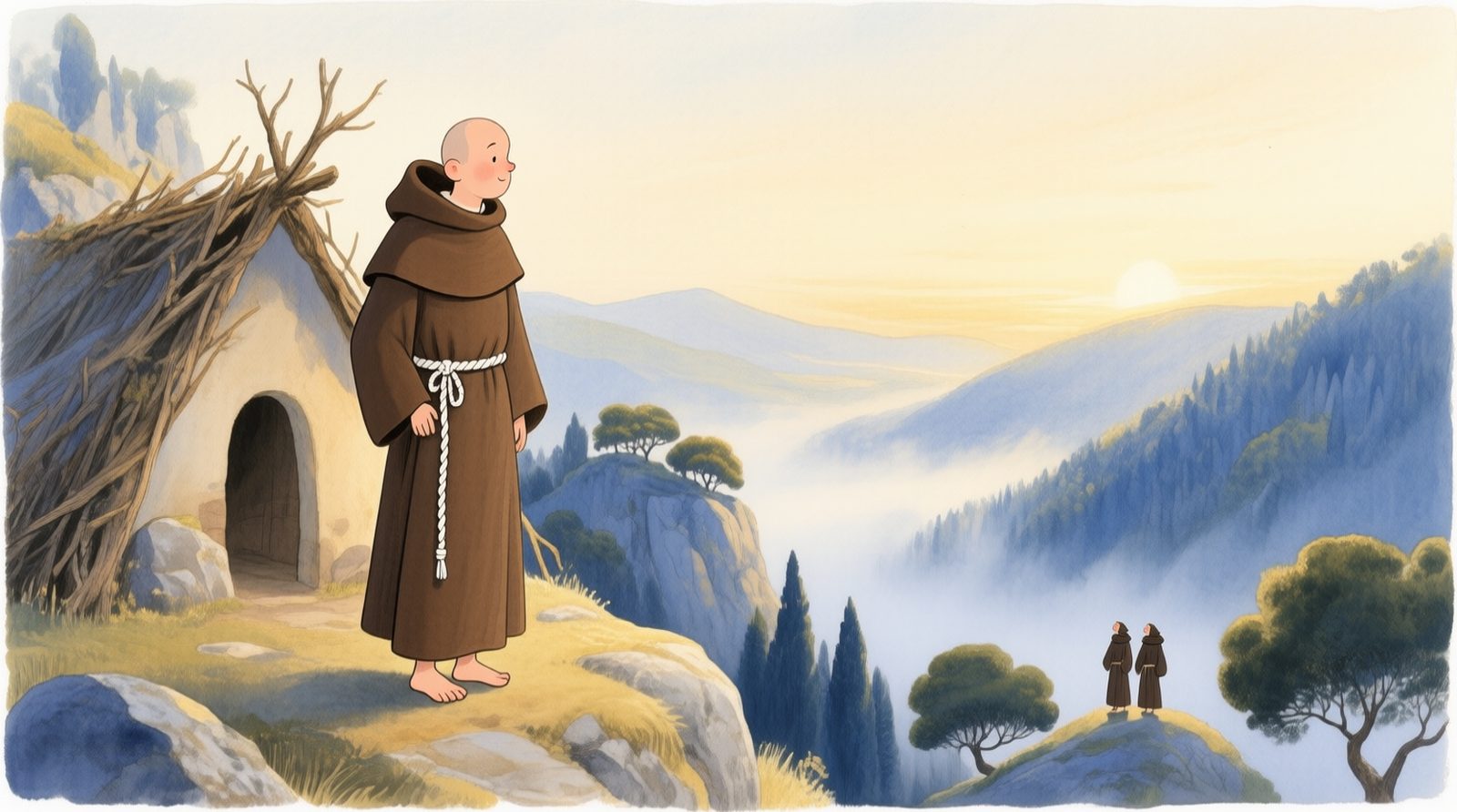
In those days, Francis meditated above all on the Passion of Christ. He thought of the sufferings of Jesus, of the cross, of the wounds, of the love. And he prayed: Lord, I want to feel what You felt; I want to love You as You loved me. Francis wept with compassion for Jesus and longed to be united completely with the sufferings of the Savior. And God answered that prayer in an extraordinary way.
September 14, 1224: The Stigmata
It was the feast of the Exaltation of the Holy Cross. Francis was praying at dawn, deep in prayer, when he saw a brilliant light coming down from the sky. In the light appeared a seraph, an angel with six wings of fire, and between the seraph's wings Francis saw Jesus crucified. The vision was beautiful and terrible at the same time.
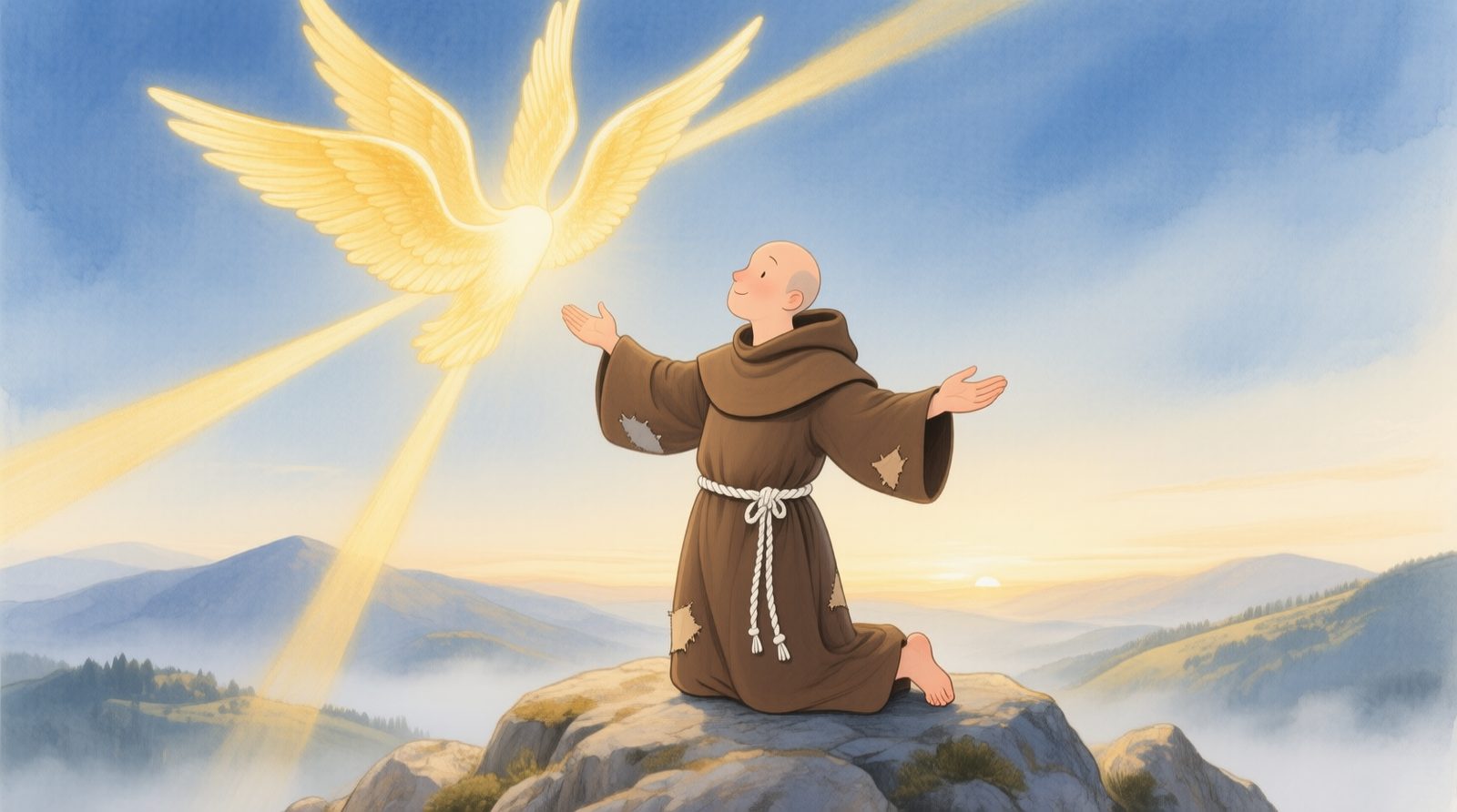
Francis was amazed and bewildered, unable to understand why Christ should appear crucified within a seraph. The vision drew closer. Rays of light streamed from Christ's wounds, and those rays touched Francis in his hands, his feet and his side. He felt an immense pain, as if nails were passing through his hands and feet. When the vision faded, Francis looked at himself and saw it: he bore on his own body the marks of Christ's crucifixion.
Francis tried to hide the wounds. He wore long sleeves, covered his feet, and told no one — out of humility, because he did not want attention. But it was hard: the wounds bled and stained his clothes, and the friars closest to him found out in the end. They were filled with wonder, certain that God had marked Francis with the wounds of Christ. Francis, however, asked them to keep it secret. It was between him and Jesus.
The Return to Assisi
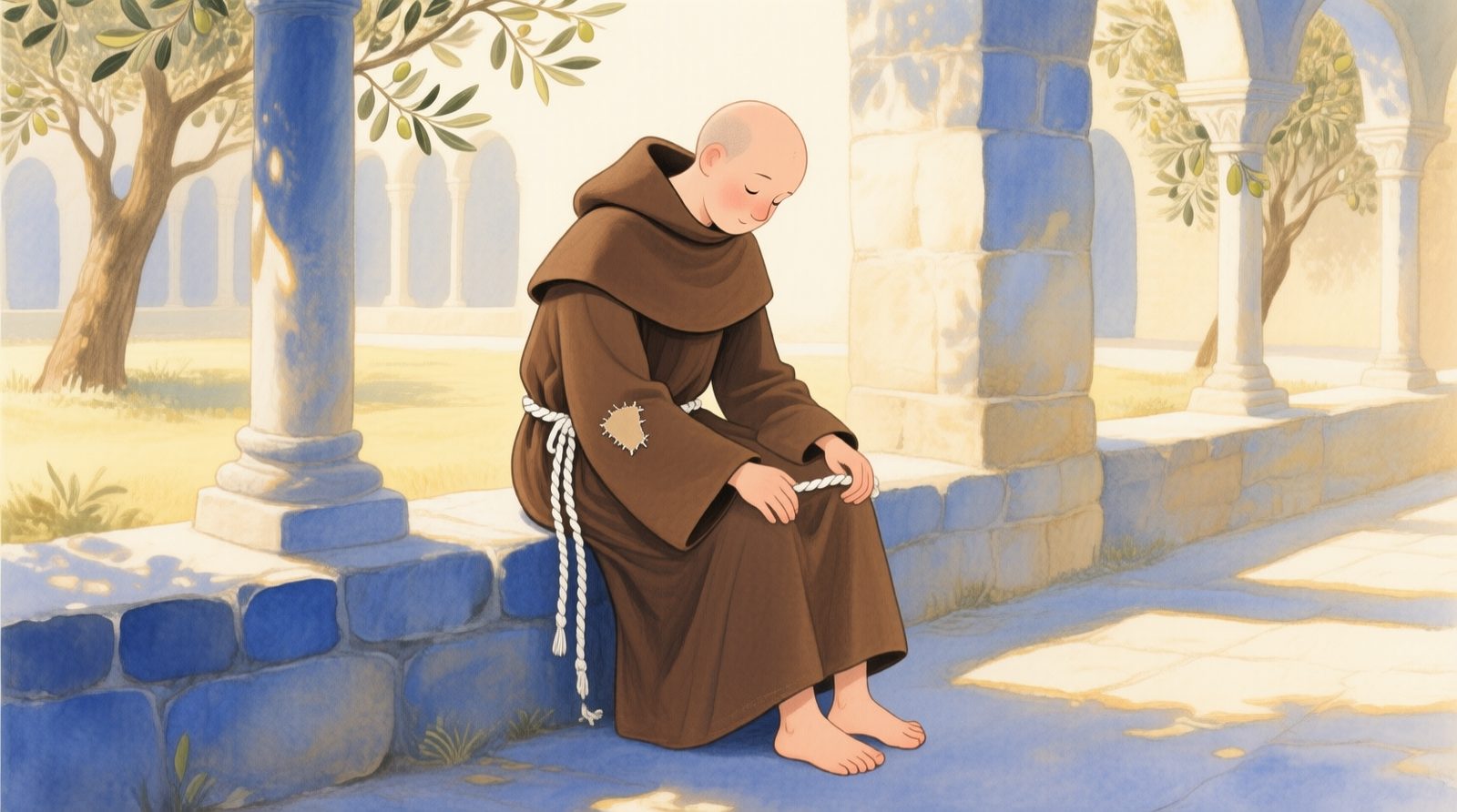
Francis came down from Mount La Verna transformed. His body was weaker than ever, the wounds ached deeply, and sometimes he had to be carried, for he could hardly walk. But his soul was radiant, closer to Jesus than ever before. He returned to Assisi, to the Portiuncula, his beloved place. There, surrounded by his friars, Francis would live his last days.
The Canticle of the Creatures
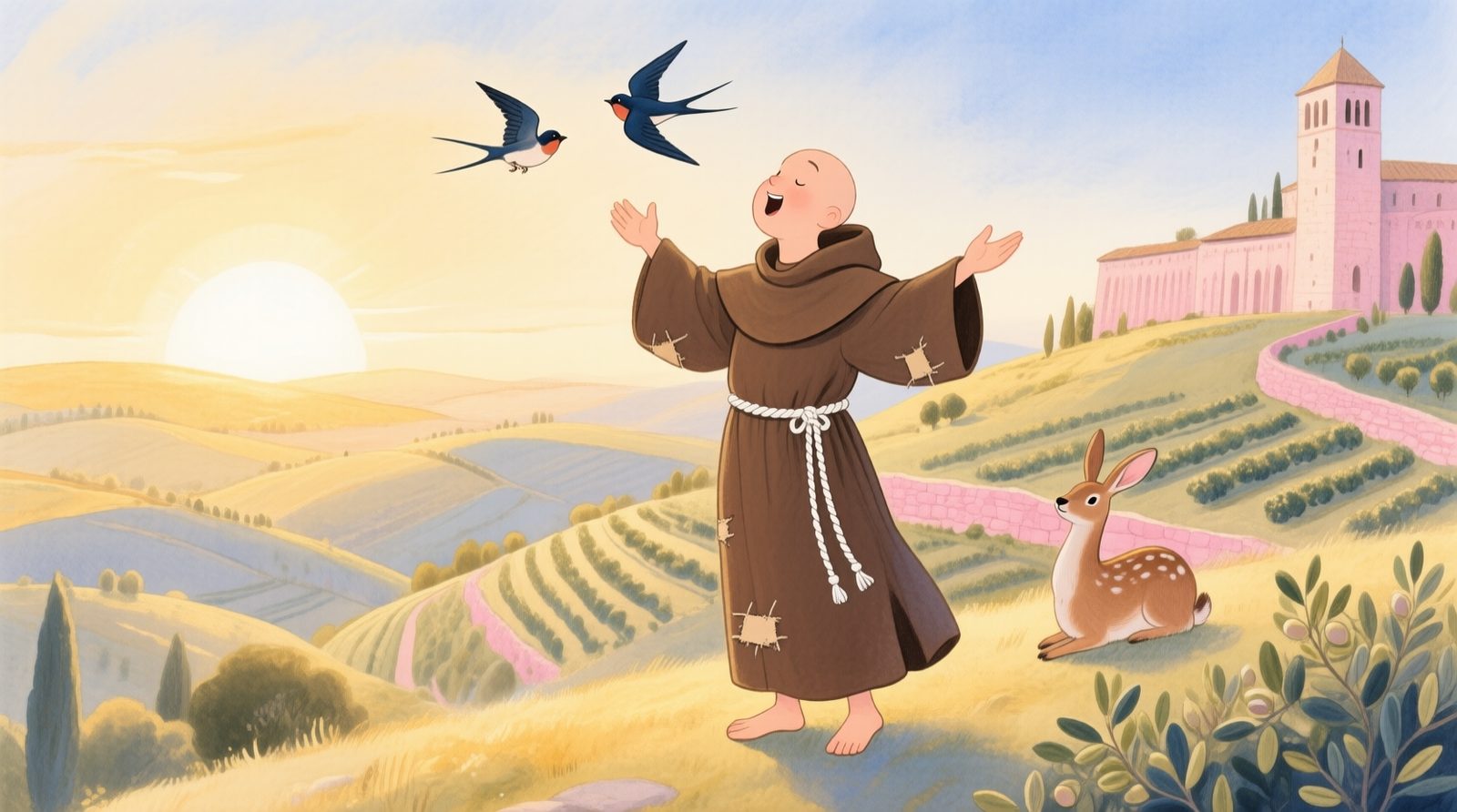
In 1225, Francis was gravely ill: almost blind, in great pain, close to death. He spent his days in a dark hut, because the light hurt his eyes. Anyone else would have been sad and discouraged. But Francis, in that darkness, composed the most beautiful song of praise to creation: the Canticle of the Creatures, also called the Canticle of Brother Sun. And he sang it in a voice that was weak, but joyful:
Yours are the praise, the glory, the honor and every blessing.
Praised be You, my Lord, with all Your creatures,
Especially Sir Brother Sun,
Who brings the day and gives us light.
Praised be You, my Lord, through Sister Moon and the Stars,
Through Sister Water, Brother Fire, and Sister Mother Earth.
Praised be You, my Lord, through those who forgive for Your love,
And bear illness and trials.
Praised be You, my Lord, through our Sister Bodily Death!"
The Last Days
In October 1226, Francis felt that he was going to die. He asked to be taken to the Portiuncula, because he wanted to leave this world from his beloved place. The friars carried him slowly, for he could barely move. On the way, Francis asked them to stop on a hill from which Assisi could be seen, the city he loved so much. He raised his hand and blessed it, calling it his mother, thanking it for everything, and said goodbye to it in silence.
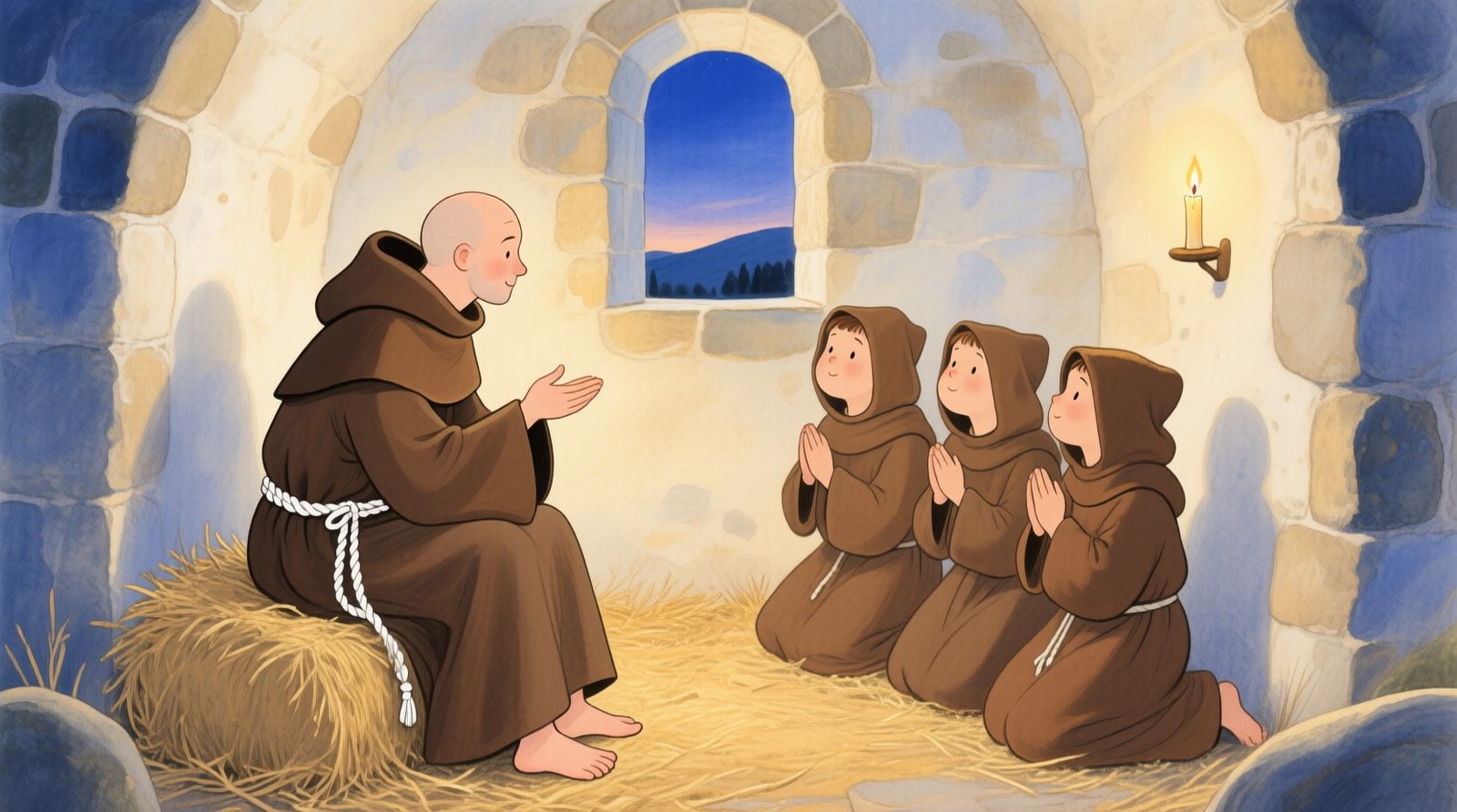
At the Portiuncula, Francis called all the friars close and gave them his last counsels, in a gentle voice. That they should always love Lady Poverty, their treasure. That they should love Holy Mother Church and be obedient. That they should love one another as Jesus had loved them. Then he asked them to read the Passion from the Gospel of John and, as he listened, he wept slowly, out of love for Jesus.
October 3, 1226: The Death
On Saturday, October 3, as evening fell, Francis was dying. He asked to be laid on the bare earth, with nothing, because he wanted to die as he had been born: poor like Christ. He asked for bread, broke it, and shared it with the friars, like Jesus at the Last Supper. Then, in a thread of a voice, he prayed the Psalm: "With my voice I cry to the Lord... bring my soul out of prison." Night came down slowly. And when it was dark, Francis died in peace, surrounded by his brothers.
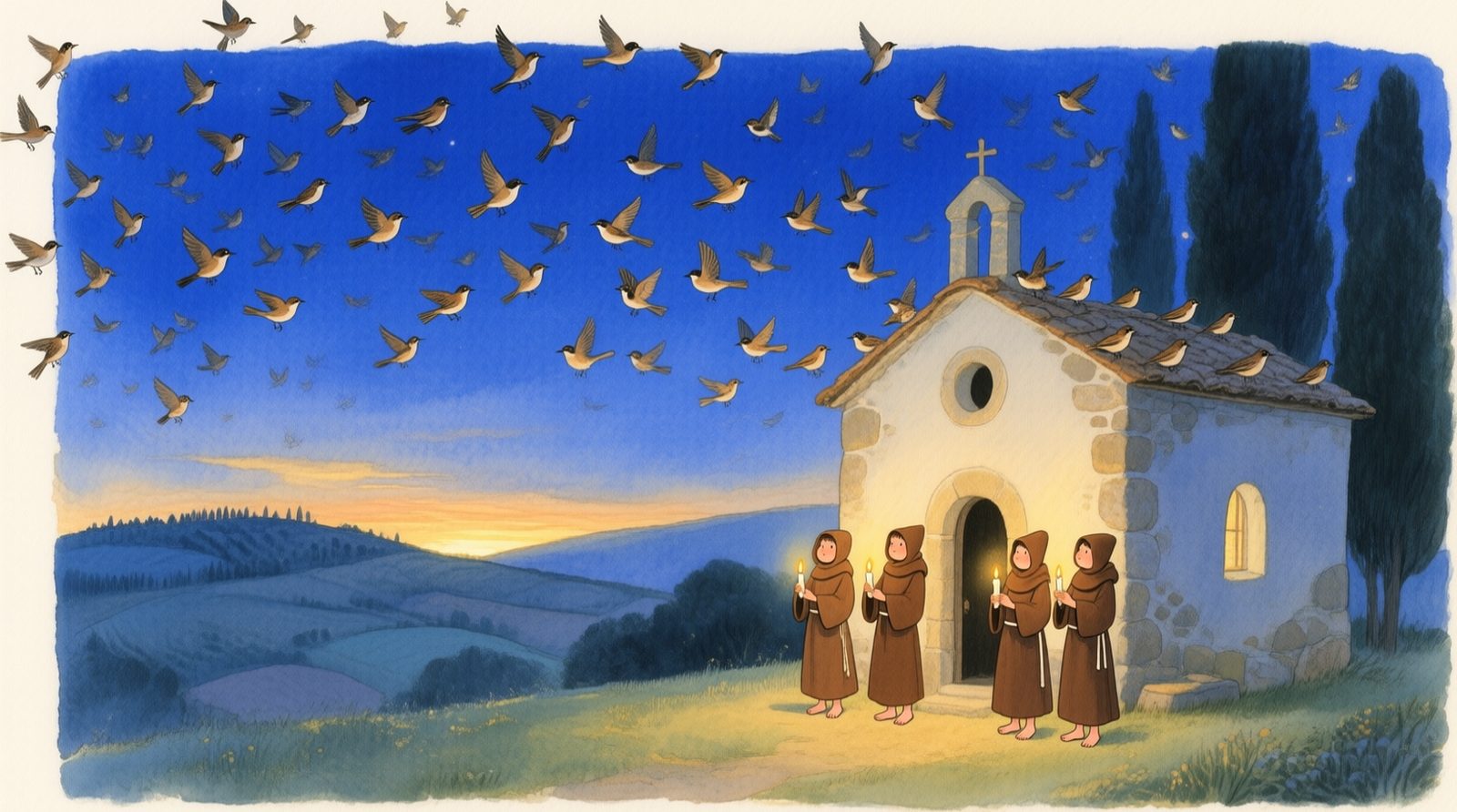
At that hour, the friars witnessed something they never forgot: thousands of larks, the little birds Francis loved so much, flew over the hut, singing in the darkness. It was as if all creation were walking with Francis to the gates of heaven. And when they prepared his body, everyone could clearly see the stigmata, the sacred wounds he had hidden for so long.
The Funeral and the Canonization
At the funeral, all of Assisi wept — and, at the same time, rejoiced, for the city knew it had a saint. The body was carried in procession and stopped at the church of San Damiano, so that Saint Clare and her sisters could say goodbye. Clare wept softly: farewell, father; farewell, friend; until heaven. Then Francis was buried in Assisi, in the church of Saint George.
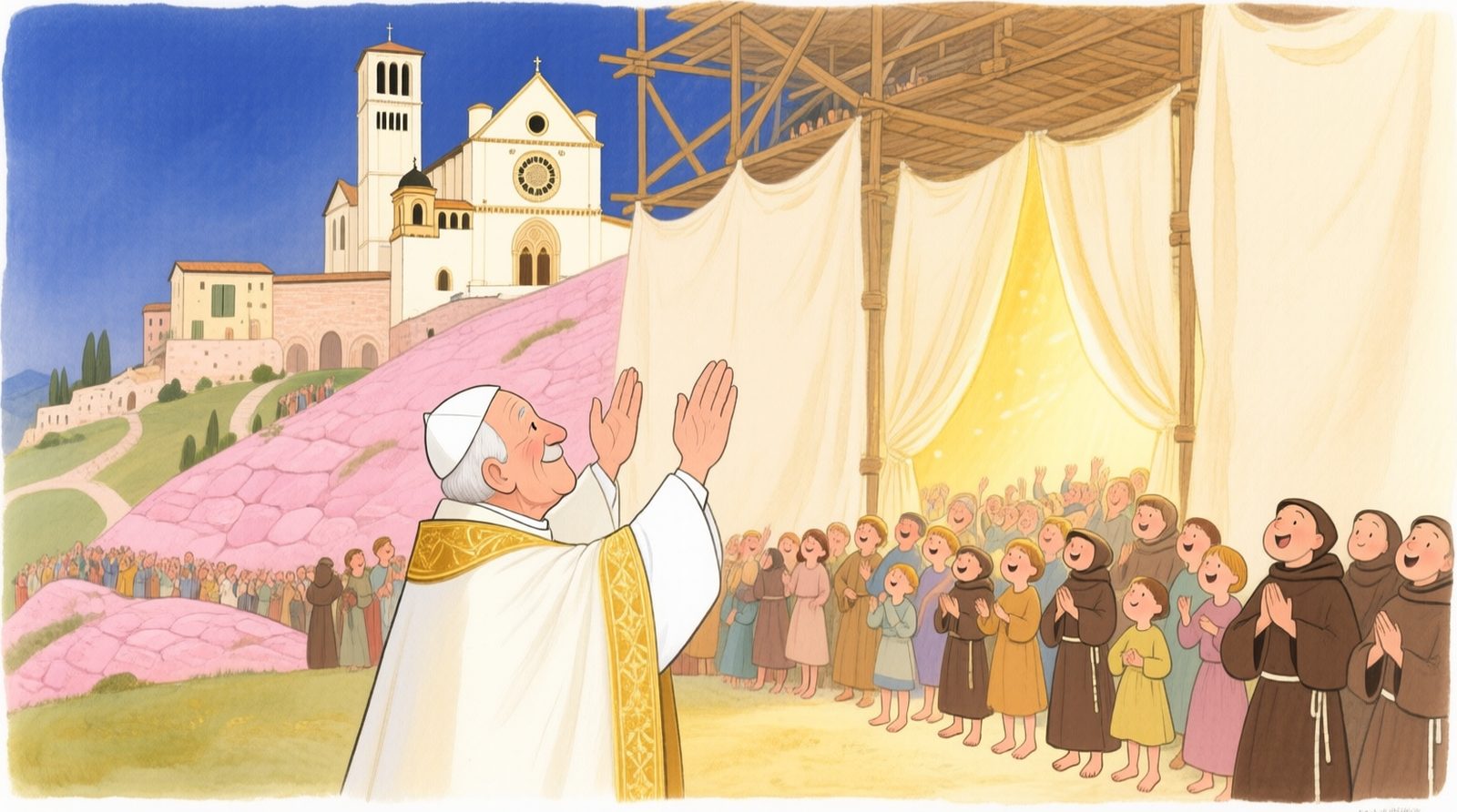
Only two years later, in 1228, Pope Gregory IX canonized Francis — one of the fastest processes in history, because it was already clear to everyone that he was a saint. The Pope ordered the building of the Basilica of Saint Francis in Assisi, today one of the most visited shrines in the world. And the Franciscan friars are still spread across the whole world, in their thousands, living the way that Francis opened.
The Legacy of Saint Francis
What Francis left to the world cannot be told in a few words. He loved Jesus above all things and showed that riches do not bring happiness. He called the sun, the moon, the animals and the plants his brothers and sisters, and taught us to see all creation as a family. He sang praises even while sick and dying, greeted everyone with "peace and all good," and wanted to be the least of all.
Today, Saint Francis is one of the most beloved saints in the world, dear even to those who are not Catholic, because he lived love in a way everyone can recognize. He is the patron of Italy, of ecology, of animals and of peace, and Pope Francis chose his name in his honor. From Francis we learn to live simply, to love generously, and to trust God with joy.
Moral of the Story


